title: Friendly & Social Skills description: [AFW P.1] Michael's Epiphany #38 published: true date: 2026-06-30T08:10:35.481Z tags: editor: markdown dateCreated: 2021-09-03T01:06:22.268Z
People Skills, Social Skills & Friendly Skills
Watch People Business vs Financial Business VIDEO
Watch Scripts to Master VIDEO
Read Nick's This Time Isn’t Different - #20 - Part 2.2 - Our Goal in All This PDF
Read Steve Siebold's Secrets of the World Class #151 - Emotional Intelligence PDF
"You're in the people business that happens to sell financial services." -Michael
“Life is about work, work is about life, and both are about people.” -Keith Ferrazzi
“Everything technical can be outsourced or delegated, and nothing 'people' can be outsourced or delegated. What I am suggesting is that you invest more time in your people skills than your technical skills because it's your people skills that get you in front of prospects and your people skills that get your hired. It's your people skills that manage your clients' expectations. It's your people skills that help you help your clients manage their emotions during turbulent times. It's your people skills that generate referrals and convert referrals into clients.” -Bill Bachrach
-
What financial advisors think is most important: technical skills.
-
What clients think is most important: interpersonal skills.
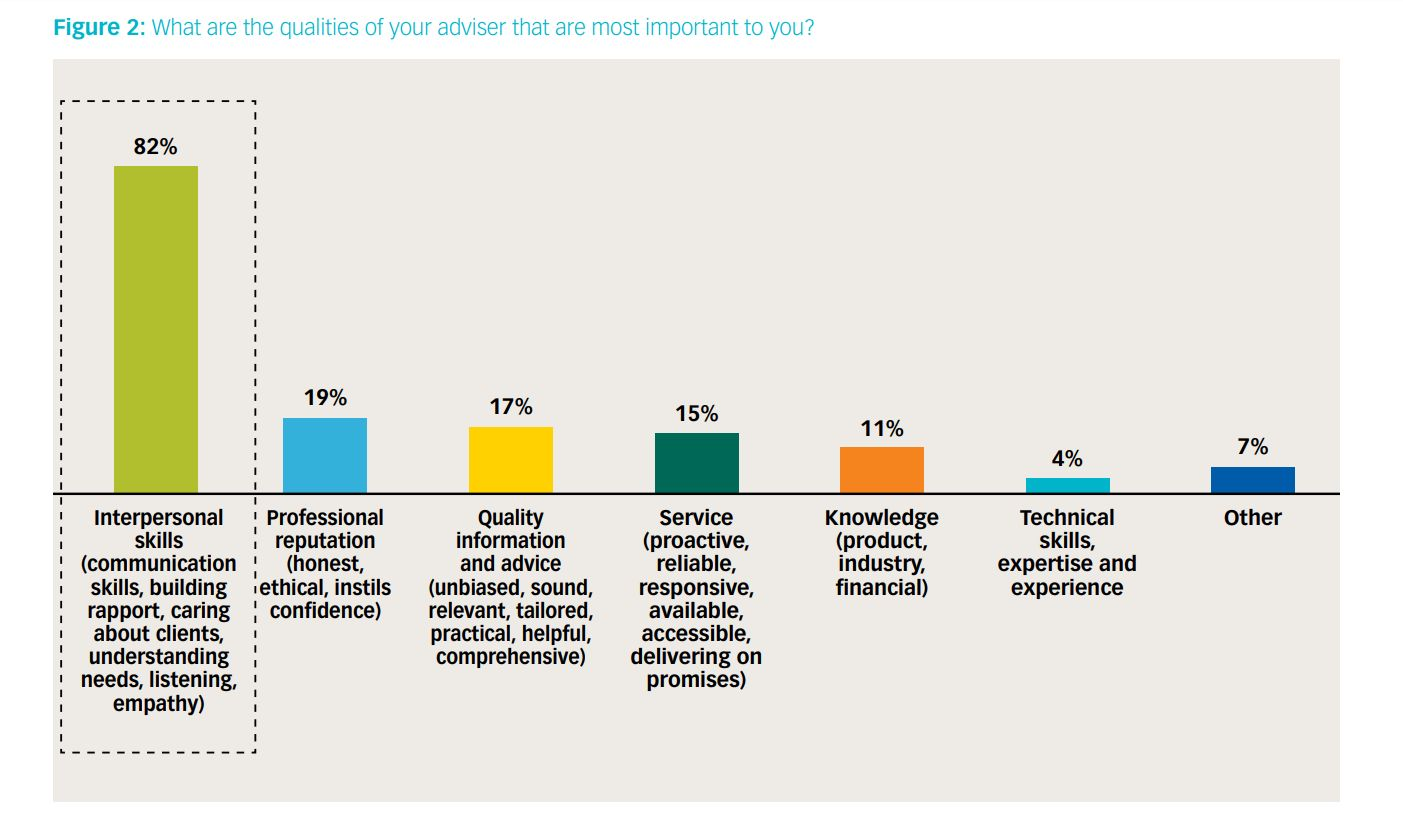
Source: "The Trusted Adviser" from the Association of Financial Advisers
The most important skills you should be constantly working on are your people skills, friendly skills and sales skills. The technical training pales in comparison. Be diligent about learning how to deal with various and disparate personalities, both internal to our team and external with clients.
- Always be nice, take the high road and kill 'em with kindness.
- Be calms and like a zen master.
- Friendly skills and social skills are the "oil" that greases the wheel of human relations.
Resources
- Visit the People Skills shelf on our Goodreads group.
The Art of Dealing with People by Les Giblin BOOK This book is a complete source for those who wish to develop people-skills.
Skill with People by Les Giblin BOOK Would you like to improve your people skills and your ability to make strong, lasting impressions on the men and women you meet every day?
How to Have Confidence and Power in Dealing with People by Les Giblin
Taking a brass tacks approach to communication, this book explains how to interact with others as they really are, not as you would like them to be. The goal is to get what you want from them successfully
10 Client-Facing Service Tips
Watch AF MKOM 1634 - 9 Client-Facing Service Tips VIDEO
- Responsiveness. "How quickly and intelligently do you respond to my needs?". Always be on time, and leave before they tire of you.. Return all calls and emails promptly.Respond asap to client inquiries. Make your answers/solutions/rsponses convenient, such as screenshots of accounts. Keep them in the loop, such as rollovers, account set-up, and progress of referrals
- Take great notes and bring them up, let them see that you were paying attention
- Have a philosophy - stick to it. Have a "My Philosophy" document.
- Send them an email intro series that introduces you and your philosophies.
- Have a monthly lient newsletter.
- Send physical thank you notes and birthday cards.
- After they become a client, or give you a successful referral, send them a nice gifts
- Connect with them on Facebook, Linkedin, X, Instagram and engage with them.
- Have simple client website that confirms your philosophies in #3.
- Use a booking service to make it easy for them to schedule appointments.
How to Win Friends & Influence People
How to Win Friends and Influence People in the Digital Age by Dale Carnegie, BOOK The only diploma that hangs in Warren Buffett’s office is his certificate from Dale Carnegie Training. Lee Iacocca credits Carnegie for giving him the courage to speak in public. Dilbert creator Scott Adams called Carnegie’s teachings “life-changing.”

Five Parts
Part I: Fundamental Techniques in Dealing With People
Three Principles
1.1: Don’t Criticize, Condemn or Complain
“Don’t complain about the snow on your neighbor’s roof, when your own doorstep is unclean.” -Chinese Proverb
“Be as polite to the custodian as you are to the chairman of the board.” -H. Jackson Brown Jr.
“The real art of conversation is not only to say the right thing in the right place, but, far more difficult still, to leave unsaid the wrong thing at the tempting moment."
Read Ryan Holiday's The Daily Stoic Book, November 13 - NEVER COMPLAIN, NEVER EXPLAIN PDF
- If you want to gather honey, don’t kick over the beehive.
- I will speak ill of no man and speak all the good I know of everybody.
- Any fool can criticize, condemn and complain - and most fools do.
- It takes character and self-control to be understanding and forgiving.
- A great man shows his greatness by the way he treats “little” men.
- Don’t focus on people’s weaknesses, focus on their strengths.
1.2: Give Sincere and Honest Appreciation
“Think of everybody you talk to as having a flashing sign on their chest saying: Make me feel special!” ―Art Williams
“People will forget what you said, people will forget what you did, but people will never forget how you made them feel."
- This is the big secret of dealing with people.
- There is only one way to get others to do something, make then want to.
- Everybody likes a compliment. The deepest principle in humans is the craving to be appreciated.
- The desire to feel important is a key difference between mankind and animals.
- I’m hearty in my approbation and lavish in my praise.
- Make people feel special. After talking with you, their self-esteem should have been raised.
1.3: Arouse in the Other Person an Eager Want
- He who can do this has the whole world with him. Who cannot walks a lonely way.
- Don’t think about what you want, think about what others want.
- The only way on Earth to influence people is to talk about what they want, and show them how to get it.
- Every act you have ever performed since the day you were born was performed because you wanted something. (Emotional desire.)
- A secret to success: the true ability to understand the other person’s point of view and see things from their angle. Seek first to understand, before being understood.
Part II: Six Ways to Make People Like You
Six Principles
"Retirees invest with people they trust... PERIOD." -Nick Murray
Clients will buy inferior products from people they trust more often than they will buy superior products from people they don’t trust.
2.1: Become Genuinely Interested in Other People
“I'd rather be an interested introvert, than an interesting extrovert.” -Tom Hopkins
“Be impatient with yourself, but patient with others. Act like a lamb, but work like a lion.” -Tom Hopkins
Read Robert Greene's TDL 07-03 - Direct Your Gaze Outward PDF
Read Robert Greene's TDL 08-03 - Make Them the Star of the Show PDF
- Do this and you’ll be welcome anywhere.
- People are interested in themselves. Pay attention to others’ needs.
- The most important quality of a professional salesperson and a leader is to be genuinely interested in other people.
- Do unselfish things for other people.
- Make things harder for yourself if it means making it easier for others.
- Be excited and happy when meeting and greeting people. Let people talk and “dump” on you. Ask open-ended questions to let them keep talking.
- People are interested in those who are interested in them.
2.2: Smile!
“A man without a smiling face must not open a shop.” -Chinese Proverb
“Your smile is your logo, your personality is your business card, and the way you make others feel is your trademark.”
Read Nick's This Time Isn’t Different - #26 - Part 2.8 - And If All Else Fails, Try a Little Gentle Humor PDF
Read Robert Greene's TDL 07-20 - Be a Source of Pleasure PDF
Read Robert Greene's Daily Laws, September 19 - Make Use of the Cat’s-Paw PDF
- A simple way to make a good first impression.
- The expression one wears on one’s face is far more important than the clothes on your back.
- The power of a smile is awesome - even when it is unseen (as in making a phone call).
- People rarely succeed at something unless they have fun doing it!
- You must have a good time meeting people if you expect them to have a good time with you.
- Think about being happy!
- Look them in the eyes with warmth and friendliness.
- If you're happy, tell your face!
2.3: Remember People's Name
- If you don’t do this you are headed for trouble.
- Develop an uncanny ability to remember a person’s name.
- Write Thank You notes to all the people you meet and use their first names.
- The average person is interested in their name more than all others.
- Appreciate people in front of others, and use their name.
- Immediately after hearing someone's name, repeat it six times (to yourself!). Mentally associate their name with their features or something else to help you remember. Also, begin using their name out load immediately (but don't overdo it).
2.4: Be a Good Listener
Read Robert Greene's Daily Laws, August 27 - Transform Yourself into a Deep Listener PDF
Read Robert Greene's Daily Laws, September 21 - Get Them to Reveal Their Intentions PDF
- Encourage others to talk about themselves.
- An easy way to become a good conversationalist is to be a good listener.
- All people want, is an interested listener, so they can expand their ego and tell what they’ve done.
- The highest compliment you can pay to anyone is to genuinely listen intently.
- People want to feel important - let them.
- Listen patiently, don’t interrupt, let them talk themselves out, and blow off steam.
- People prefer good listeners to good talkers. People want to unburden themselves.
- Give extraordinary attention.
- Ask questions others will enjoy answering. For example, “How did you manage that?!?”
2.5: Talk in Terms of the Other Persons' Interests
Read Robert Greene's TDL 08-07 - Consider Their Self-Interest PDF
Read Ryan Holiday's The Daily Stoic, August 23 - IT’S IN YOUR SELF-INTEREST PDF
- Read up on the subject in which your guest is particularly interested.
- The royal road to a person’s heart is to talk about the things he or she treasures most.
- Talk in terms of what interests the other person and whatever pleases him/her, and whatever catches his/her enthusiasm.
- Talking in terms of the others person’s interests pays off for both parties.
2.6: Make the Other Person Feel Important
- The deepest principle in human nature is the craving to be appreciated. People want recognition of their true worth and a feeling of importance.
- Do unto others as you would have them do unto you.
- Use phrases such as, “I’m sorry to trouble you.” “Would you be so kind as to. . .” “Won’t you please.” “Would you mind?” and “Thank you.”
- Every man I meet is my superior in some way. In that I learn of him - and in some subtle way I recognize his importance.
- Give praise and recognition in front of other people. Do it in public. Do it all the time.
- Talk to people about themselves and they will listen for hours!
- Become genuinely interested in other people.
Part III: How to Win People to Your Way of Thinking
Twelve Principles
3.1: The only way to get the best of an argument is to avoid it.
“A man convinced against his will is of the same opinion still.” -Samuel Butler
“When two partners always agree, one is not necessary.” -Dale Carnegie
Read Ryan Holiday's Daily Stoic lesson The Truly Educated Aren’t Quarrelsome PDF
Read Robert Greene's TDL 08-08 - Avoid Argument PDF
Read Robert Greene's Daily Laws, August 17 - Persuade with a Light Touch PDF
- Always avoid the acute angle.
- Do not become argumentative.
- You can’t win an argument. If you lose it, you lose it; and if you win it, you still lose.
- How to keep a disagreement from becoming an argument:
- Welcome the disagreement.
- Distrust your first impression.
- Resist becoming defensive.
- Control your temper.
- Seek first to understand, before being understood.
- Look for areas of agreement.
- Be honest and admit errors. Admit where they’re right.
- Promise to think over your opponent’s ideas – and do it.
- Thank your opponent sincerely for their interest and time.
- Postpone action to give both sides time to think through the problems.
3.2: Show Respect for the Other Person's Opinions. Never say, "You're Wrong."
“Men must be taught as if you taught them not.” -Alexander Pope
“Be wiser than other people if you can; but do not tell them so.” -Philip Stanhope
Read Robert Greene's TDL 06-07 - Never Impugn People’s Intelligence PDF
- If you tell people they are wrong, do you make them want to agree with you?
- Never begin by announcing, “I am going to prove so-and-so to you.” This arouses opposition and makes the listener want to battle with you before you even start.
- If you are going prove anything, don’t let anybody know it. Do it so subtly, that no one will feel that you are doing it.
- Never contradict directly. Begin by saying: “Well, I thought otherwise, but I may be wrong I frequently am. And if I’m wrong I want to be put right. Let’s examine the facts…”
- Treat people courteously, diplomatically and respectfully. Propose your ideas modestly.
- Most of our so-called reasoning consists in finding arguments for going on believing as we already do.
3.3: If you're wrong, admit it quickly and emphatically.
“Brag the objection." -Tom Hopkins
“Never ruin an apology with an excuse."
- If we know we are going to be rebuked anyhow, isn’t it far better to beat the other person to it and do it ourselves?
- It is much easier to listen to self-criticism than to bear condemnation from another.
- Say about yourself all the derogatory things you know the other person is thinking or wants to say, and say them before they have a chance to.
- Your eagerness to criticize yourself may take all the “fight” out of your opponent.
- When we are right, let’s try to win people gently and tactfully to our way of thinking, and when we are wrong, let’s admit our mistakes quickly and with enthusiasm.
3.4: Always begin in a friendly way.
- People cannot be forced to agree with you. But they may possibly be led to if we are gentle and friendly. Gentleness and friendliness are always stronger than fury and force.
- First convince him that you are his friend.
- Begin with friendly remarks: “This may, perhaps, be worth thinking of…”, “You, with your knowledge of x, will easily see the significance of these facts…”, “I would think the same thing in your position, however, in this case…”
- Use a soft-spoken, quiet, friendly approach. Begin with good will and enthusiasm.
3.5: Use the secret of Socrates. Ask questions. Get the other person saying, "yes, yes" immediately.
- Don’t begin be discussing the things on which you differ. Begin by emphasizing the things on which you agree. Emphasize that you both are striving for the same goal and your only difference is one of method and not purpose.
- Get the other person saying, “Yes, yes” at the outset. Keep him, if possible, from saying “No.” Get him moving in the affirmative direction.
- The best way to get a “yes” response is to ask questions with which your partner has to agree. Keep on winning admission after admission until you have an armful of yeses. Finally, almost without realizing it, he will find himself embracing a conclusion he would have bitterly denied a few minutes previously.
3.6: Let the other person do a great deal of the talking.
“If you want enemies, excel your friends; but if you want friends, let them excel you.” -Dale Carnegie
- Let the other person talk themselves out. So ask questions and let them tell you a few things! If you disagree you may be tempted to interrupt. But don’t. They won’t pay attention to you while they still have a lot of ideas to express. So listen patiently and with an open mind. Be sincere about it. Encourage them to express their ideas fully.
- Find out about the other person’s interests and problems.
- Most of our friends would rather talk to us about their achievements than listen to us boast about ours.
3.7: Let the other person feel that the idea is his or hers.
- Isn’t it bad judgment to try to ram your opinions down the throats of other people? Isn’t it wiser to make suggestions – and let the other person think out the conclusion?
- Consult people about their wishes, desires, ideas and opinions.
- No one likes to feel that he or she is being sold something. They much prefer to feel that they are buying on their own accord and acting on their own ideas.
- Sometimes the best way to convert someone to an idea is to implant it in his mind casually, just to interest him in, so as to get him thinking about it on his own account.
3.8: Try honestly to see things from the other person's point of view.
“Seek first to understand, before being understood.” -Stephen Covey
“If you can't intelligently argue for both sides of an issue, you don't understand the issue well enough to argue for either."
- Other people may be totally wrong, but they don’t think so!
- There is a reason why the other person thinks and acts as she does. Ferret out that reason and you have the key to her actions, perhaps her personality.
3.9: Be sympathetic with the other persons' ideas and desires.
- Success in dealing with other people depends on a sympathetic grasp of the other person’s viewpoint. Show that you consider the other person’s ideas and feeling as important as your own.
- “I don’t blame you one iota for feeling as you do. If I were you I would undoubtedly feel just as you do.”
- Feel sorry for the poor devils. Pity them. Sympathize with them. 75% of the people you will ever meet are hungering and thirsting for sympathy. Give it to them, and they will love you.
3.10: Appeal to the nobler motives.
Read Robert Greene's TDL 06-09 - Give People the Opportunity to Feel Superior PDF
- All the people you meet have a high regard for themselves.
- A person usually has two reasons for doing things: one that sounds good and the real one. The person will think of the real reason himself. But all of us, being idealists at heart, like to think of motives that sound good. So, in order to change people, appeal to their nobler motives.
- Assume that people are sincere, honest, truthful and willing to do the “right thing.” Make them feel that you consider them to be upright and fair.
3.11: Dramatize your ideas.
- This is the day of dramatization. Merely stating a truth isn’t enough. The truth has to be made vivid, interesting, dramatic. You have to use a little showmanship.
- Use props, visual aids and get the prospect involved in the presentation. (example: pencils, zip-loc bags, stuffed animals, stamps, etc.)
3.12: When nothing else works, throw down a challenge.
Read Robert Greene's Daily Laws, August 11 - Use Their Emotions PDF
- The way to get things done is to stimulate competition. Invoke the desire to excel! The challenge! Appeal to people’s spirit!
- “I don’t blame you for being scared. It’s a tough business. It’ll take a big person to see this through.”
- Give people the chance to prove their worth, to excel, to win. The desire to feel important.
Part IV: How to Change People Without Giving Offense or Arousing Resentment
Nine Principles
4.1: Begin with praise and honest appreciation.
- It is always easier to listen to unpleasant things after we have heard some praise of our good points.
- Use the “sandwich” method.
- Say something good.
- Give the item of improvement.
- Say something good.
4.2: Call attention to people's mistakes indirectly.
- Don’t give praise then use the word “but” followed by criticism. It negates all the good you just said. Use the word “and” or "however" instead.
- Refer to another person in a similar situation, instead of them directly.
- When trying to change a habit someone has, appeal to their leadership abilities.
4.3: Talk about your own mistakes first before criticizing the other person.
- Remember what it was like when you were starting out.
- “You have made a mistake but it’s no worse than many I have made. The proper judgment only comes with experience, and you are much better than when I started. I have been guilty of so many silly, stupid things myself, that I have very little right to criticize anyone else. However, don’t you think it would have been wiser if you have done so and so?”
- Admitting one’s own mistakes – even if you haven’t corrected them – can help convince someone to change his behavior.
4.4: Ask questions instead of giving direct orders.
- No one likes to take orders. Give suggestions instead.
- “You might consider this…”
- “Do you think that would work?”
- “What do you think of this?”
- Give people the opportunity to do things themselves; never tell them to do things directly. Also, let them do it on their own and learn from their mistakes.
- Your goal is to save a person’s pride and give her a feeling of importance.
- Asking questions not only makes an order more palatable; it often stimulates their creativity. People are more likely to accept an order if they have had a part in the decision that caused the order to be issued.
4.5: Let the other person save face.
Read Robert Greene's Daily Laws, August 10 - Anchor Their Ego PDF
- A considerate word, a genuine understanding of the other person’s attitude goes far toward alleviating the sting of telling someone they are wrong.
- Don’t criticize people, find fault, or issue threats in front of other people. Do it in private.
- If someone makes a mistake, let them understand that others have done it too, in fact, YOU have done it, and it is no big deal. Don’t destroy their ego.
4.6: Be hearty in your approbation and lavish in your praise.
- The moment someone shows the slightest improvement, praise them.
- People will do things for praise and recognition that they won’t do for money.
- When criticism is minimized and praise emphasized, the good things people do will be reinforced and the poorer things will atrophy for lack of attention.
- Make the praise specific as possible.
4.7: Give the other person a fine reputation to live up to.
Read Robert Greene's TDL 06-23 - Play to Their High Self-Opinion PDF
Read Robert Greene's TDL 08-30 - Imagine Them in the Best Light PDF
- The average person can be led readily if you have his or her respect and if you show that you respect that person for some kind of ability.
- Assume a virtue, even if they have it not.
- State openly that the other person has the characteristic that you want them to develop.
- Praise the other person for every small sign of the virtue you want to amplify in them.
- When prospecting reps from a company that prides itself in helping clients, appeal to their reputation of being "crusaders" and building a business for the "little guy".
- "Because you care so much for your clients, wouldn't it be great to be able to offer them term insurance and securities from the independent market? Isn't that what they expect you to do?"
- "If there was a business model that would be more beneficial to the advisors who are following you, doesn't it make sense to seriously investigate, if just for them?"
4.8: Use encouragement. Make the fault seem easy to correct.
- Praise the smallest improvement, and minimize the errors.
- Be liberal in your encouragement, make the thing seem easy to do, let the other person know that you have faith in his ability to do it.
4.9: Make the other person feel happy about doing the thing you suggest.
- Be sincere. Do not promise anything that you cannot deliver. Forget about the benefits to yourself and concentrate on the benefits to the other person.
- Know exactly what it is you want the other person to do.
- Be empathetic. Ask yourself what is it the other person really wants.
- Consider the benefits that person will receive from doing what you suggest.
- Match those benefits to the other person's wants.
- When you make your request, put it in a form that will convey to the other person the idea that he personally will benefit.
Part V: Extra Tips
Fifteen Tips
5.1: Respectful
Being respectful tells people you not only care about others, but you care about yourself. The most important part of being respectful is respecting yourself; if you don't, people won't respect you. Being respectful is something that should be incorporated into your everyday lifestyle and part of your regular social skills. Being respectful is shown in a lot more ways than just using your "please" and "thank you." You also need to feel respect for someone even if they don't respect themselves or you. Or at least act like it. Remember- It takes respect to earn respect. A great technique for giving respect is to empathize or relate to the other person. Listening and responding intelligently, seriously, and beneficially shows a great amount of respect. Everyone wants what they say to be heard and taken into consideration. Here are a few steps that also would help you learn how to be respectful.
5.2: Appropriate
The advantages of knowing how and when to be socially appropriate are numerous. Improved social harmony, strengthened social bonds, and more active, fluid conversations are just a few advantages. Being socially appropriate is a valuable social skill that can pay dividends.
5.3: Always be polite
Socially appropriate individuals are generally very polite and courteous in their social interactions. If the truth would hurt or cause unnecessary pain or grief, keep it to yourself in a social setting.
5.4: Be a good sport
Being socially appropriate and socially adept means being a good sport and playing along in various social encounters, no matter how boring or dull. As diverse as society and people are, the chances of being stuck in a dull, irritating or anxious social situation are high. So, be a good sport and just play along, or endure. Smile, nod and play the social games.
5.5: Check your ego
Nobody likes a braggart or a blow-hard. To be a likeable, socially adept and socially appropriate individual, keep your ego in check. To maximize social harmony and to increase social interaction, it's always better to let the other person do the talking and the boasting. Be quietly confident and secure. Refrain from ego thumping.
5.6: Conform to the social climate
A hallmark of a socially adept, socially skilled individual is the ability to adjust her social behavior to fit the tone, or climate, of a particular situation. Be respectful of the unique characteristics and expectations inherent to typical social situations, such as weddings, funerals, study groups or first dates.
5.7: Communicate and be clear
What do you want? Tell your coach/trainer what you are trying to accomplish in this business. Your "why?" is the most important element of your success. It will help you and your trainer keep you on track.
5.8: Show up and be early
Your goal should never be to be on-time, but to be early. Punctual people use the extra five or 10 minutes as a chance to catch up on emails, read over notes, or simply enjoy the solitude. See this article 4 HABITS OF PUNCTUAL PEOPLE.
5.9: Be totally positive
The business is already hard, don't make it more difficult for you and others by being negative. You should be TOTALLY POSITIVE ALL THE TIME. When you come to the office, or meet with your people, leave your problems at the door. We ALL have problems. 90% of people don't care about your problems, the other 10% are actually glad you have them. Leave your challenges and issues at the door. Come in with a super-positive disposition and a smile on your face. Pass negatives up, and positives down and sideways.
5.10: Don't take anything personally.
Is it really a big deal? Remember, the other person is doing and saying what they believe is correct. You don't have to agree, but try to realize that they don't mean to be mean, strange, odd or offensive. Half of communication is how you interpret the message. I learned this in India. On the other hand, realize that other people WILL take what you say personally! Be tolerant with other's comments to you, but be very, very careful with your comments to them! Not fair, I know! Be tough on yourself and forgiving with others (not the reverse). Let it go quickly. After a couple of days, it doesn't count anymore! Life is too short.
5.11: The only thing you can control is YOU
You can't make the other person or persons change anyway. Some clients or recruits will say "no" regardless of what you do. Some downlines won't listen regardless of how much you want to help them. You can, however, control how you let the issue affect you, and if you amplify by dwelling on it incessantly it may ruin your psyche. Forgive & forget.
5.12: Use the Golden Rule
Give the benefit of the doubt. We're all doing the best we can within the constraints of our personalities.
5.13: Don't gossip
“Whoever gossips to you will gossip about you.” -Spanish proverb
Resist the temptation. It NEVER helps. It only perpetuates the perceived problem.
5.14: Treat people like adults
Remember, they're in our business to build a life, they don't have a life for the business.
5.15: Meeting Etiquette
- Please RSVP to Calendar invites. Emily Post advises anyone receiving an invitation should reply promptly, whether attending or not, and should reply within a day or two of receiving the invitation. "Anyone receiving an invitation with an R.S.V.P. on it is obliged to reply; and breaching this standard as inexcusably rude."
- The impression you make is very important and people judge you by it. Dress well and be on your best behavior - especially at MKOM.
- Dress business casual or better.
- Bluetooth headsets should be removed during the meeting (tip: anytime you are speaking with someone, remove it).
- Please lets not get up too often during the meeting. If you "gotta go" then okay, but otherwise it is disruptive.
- "B.S." Beyond Scope. During the meeting lets keep the questions and comments within the spirit of the current topic. Use your best judgement.
- Don't "talk shop" before, during, or after the meeting.