You Are What They're Buying
Visit The Messenger is the Message AFW M.1.46
Watch Why Should I Hire You? (2022-07) VIDEO
Watch Why Should I Hire You? (2022-11) VIDEO
Read the article "Advocating Fiercely for Your Fee" in Nick Murray's NMI 2024-04 PDF
Remember, you are the product and the reason your clients should hire you is you - not the product(s). Read Ephipany #46 - The Messenger is the Message.
Warning: wisdom sold separately!
Most financial advisors sell facts, stats and products. Some of the more experienced ones offer true advice. And a few very seasoned advisors offer wisdom.
A planner is mile wide and an inch deep. A specialist is an inch wide and a mile deep.
The one-word that encompasses why you are different - and why they should hire you - is: counter-cultural.
“The investor needs a confident, seasoned professional like you, keeping him on the right track... making sure he stays diversified and insulated from his own tendencies toward greed and fear.” -Nick Murray from the book Serious Money
What Makes You Different (Your Principles)
Watch Your Three Value Prospositions VIDEO
1. Do What's Right
This has been my guiding philosophy since I started in this industry over 34 years ago. When I sit with a client I ask myself, "What would I do for myself and my family if I were in this situation?" Then that's what I recommend.
“The truth tellers have no competition.” ―Nick Murray
“I want to be happy by doing well by doing good.” ―Michael
For more details visit What Would I Do.
2. Make a Complex Subject Simple
I keep my presentations, explanations, strategies and investments as simple as possible. I don't use fancy jargon nor try to impress you with sophisticated language, charts and graphs.
Much of what I teach my clients can be understood in minutes, but the certainty of that advice can take years, or even decades, to establish. That is the value of having an experienced professional - getting a simple and confident answer quickly that might otherwise take you days or weeks of research to find.
“Everything must be made as simple as possible, but no simpler.” ―Albert Einstein
Question: “If your GPS offered a route that would save you thirty minutes on your way to an important meeting, would you take it?” Bridge: “I can tell you exactly what to do and where to go so you don’t have to take the long way.”
3. Proper Investor Behavior via Coaching
At the end of an investor’s life, 95% of his total lifetime return will come from how the investor behaved. And the primary determinant of that behavior will be the quality of the advice he got, or didn’t get. I believe you will do far better in real life with an empathetic, tough-loving behavioral coach than you will on your own.
“Without an adequately compensated advisor to help with selection and discipline, the individual investor will simply make all the classic and horrendous mistakes.” ―Nick Murray
“A large part of our value proposition is helping our clients not make the Big Mistake.” ―Nick Murray
“An advisor who can modify your behavior is one of the most important investments you make.” ―Chris Davis
“People make better decisions with financial advisors.” ―Robert Shiller, Nobel Prize-winning economist
Read Nick's Around the Year October 4 - The Card: 3 Essential Ideas PDF
Read Nick's Around the Year October 5 - Decoding the Card PDF
Read Nick's This Time Isn’t Different - #18 - Part 1.17 - What We Do, and How We Earn Our Fee, on the Back of an Envelope PDF
What I Do and How I Earn My Fee
| --- | ---:| | Crafting a long-term plan and funding the plan with a long-term portfolio... | 20% | | Coaching clients to continue following the plan through all the cycles of the economy, and all the fads and fears of the market... | 80% | | Analyzing/interpreting the economy and current events. Timing the market, calling tops and bottoms. Identifying consistently top-performing investments... | 0% | | | 100% |
The second area - the 80% - is specifically what is counter-cultural and why they should hire you. And, that you do not focus on the third area at all.
Help vs No-Help
Watch MKOM 1605: How to Handle 'It/You Cost Too Much' YOUTUBE VIDEO
“Everybody wants to hire the best. Nobody wants to pay them the best.” ―Naval Ravikant
"When you hire an expensive lawyer, you may or may not get what you pay for. But when you hire a cheap lawyer, you will DEFINITELY get what you pay for.”
“Your fee only becomes an issue to the extent that your value has been impugned.” -Nick Murray
“If you wanted to run a marathon, would you train with a coach or just hope for the best?”
“If you wanted to remodel your home, would you hire a licensed contractor or the cheapest guy off Craigslist?”
The overarching message is “You’re paying me a meaningful fee to give you great advice. For heaven’s sake, please always avail yourself of that advice. Please just check in with me whenever you’re considering an investment move — or indeed any major financial move — and give me the opportunity to render the advice you’re already paying for.” -Nick Murray
Read Nick's ATY 143 May 23 - Do You See It Now? PDF
Read Nick's NMS 23 - Your fee in its purest essence PDF
Read Nick's NMS 58 - Why am I paying you for doing nothing? PDF
Read Nick's NMS 59 - How can you charge twice as much for a $3M account as for $1.5M? PDF
Read Nick's NMS 60 - Why am I paying you to underperform the S&P? PDF
Read Nick's NMS 61 - Why don't I just buy index funds? PDF
- The issue is never "High-cost vs low-cost" or "fee vs no fee" but "help vs no help". You are the "help".
- This is the financial services industry not financial products industry.
- Remember, the messenger is the message
The goal-focused, plan-driven, long-term financial advisor knows three things to be true:
-
You will cause the client’s long-term portfolio return to exceed that which the client would earn on his own.
-
You will save the client meaningful amounts of time, effort, worry and record-keeping.
-
You wil coach the client out of making the great human behavioral mistakes of investing, not once but several times over the course of an advisory relationship.
Script 1
Prospect Why should I pay a sales-charge or fee?
Advisor "Only one reason. The fee pays for me. See, it's never an issue of fee vs no-fee; it's an issue of help vs no-help."
Advisor “Since the value of what I do for you and your family is so much greater than what I charge, you’ve got me stumped here.”
Script 2
This script is adapted from the book The Excellent Investment Advisor, pages 12 - 13, by Nick Murray.
Advisor It is quite possible to become an immensely successful investor without ever having owned a fund with more than three stars. You just have to dollar-cost average into those funds every month of your working life. Then, when you retire, you do the reverse. At the end of an investor's life, less than 5% of his total lifetime return will come from what his investments did versus other, similar investments. The **other 95% will come from how the investor behaved. And the primary determinant of that behavior will be the* quality of the advice he got, or didn't get. My philosophy is that you will do far better in real life with an empathetic, tough-loving behavioral coach than you will on your own.*
Some of the value that I provide:
- I have access to the "open market" meaning I am not tied to a particular product provider, thus I can be impartial and truly do what's right for you.
- Coaching you to continue to do the right things and help you avoid the "Big Mistake", especially in the midst of confusion and misinformation.
- Maybe most importantly take the stress and pressure off of your shoulders and allow you to worry about other things like your family and your career.
Look at my fee as an insurance premium; you pay a small fraction to keep you from ill-considered decision which would ultimately cost you multitudes more than what I earn.
Script 3
Are Financial Advisors Too Expensive?
Maybe they are. But so is...
- Making bad investments.
- Falling for emotional decision-making during market downturns.
- Paying too much in taxes.
- Being too conservative in your investments.
- Being too aggressive in your investments.
- Getting wrecked by inflation because you didn't hedge against it.
- Overpaying for insurance you don't need.
- Underpaying for insurance you do need.
- Ignoring estate planning and leaving your heirs with a mess.
- Spending too much in retirement because you didn't plan properly.
- Spending too little in retirement because you're afraid to run out.
Pick you "expensive".
You see, It's not “fee vs no fee” but “help vs no help”.
One of my principles is to "always do what's right" and that includes the method of how I charge fees. I can promise you that through out the years we work together the quality of advice that I give you will far outweigh any fees that I earn.
How much do you get paid?
"You never, never defend your fee. Doing so is beneath you. Specifically, the answer is: Thank you for your inquiry. I never discount my fee, which I sincerly believe is a fraction of what it's worth." -Nick Murray
Read Nick's ATY 034 February 03 - Empathetic Vigilance PDF
Read Nick's NMS 21 - The great three-in-one value proposition question PDF
Read Nick's NMS 22 - Advocating fiercely for your fee PDF
Watch How do you get paid? by Andreas Reiter VIDEO
Avoid saying, "make money off of you". Avoid the word "commission". Instead use "my income", or "this is how much I get compensated to help you build a guaranteed income stream for life."
Question: “If you needed heart surgery, would you choose the cheapest surgeon you could find, or the one with the best track record of saving lives?” Bridge: “It’s the same with financial planning. Sure, you could pay for the cheapest option, but it makes more sense to pay for expertise that protects you from mistakes in the long run
The Script
Advisor "Mr. Johnson, I'm fortunate that my fee for service is built into every product - you'll never write me a check. In other words, the company compensates me directly for the high level of service I give to each and every client. My philosophy is to do well by doing good, and I believe that the value of my advice is worth multiples of what I would ever be allowed to charge for it. Sometimes I'll earn all your fees in just one day's advice."
I don't want to pay "Commissions", but I'm okay with "Fees".
Visit Advisory & Fee-Based AFW S.8 for more details on the differences between A-shares vs fees.
Read Nick Murray's article "Explaining Fees" on page 83 of the Nick Murray Reader BOOK.
Watch I don't want to pay commissions, but I'm okay with fees VIDEO
I never understood this question about compensation. Commission = fees; and fees = commissions. They're the same, it's an old marketing trick in the industry. Surprisingly, fee-based is often more expensive than "commissions". But that's not really the point. The real issue is always the quality of advice.
C-shares mutual funds and VA are "fee-like". Only A-share funds are what people typically consider "commissions", and yet they're the most inexpensive way to purchase securities!
I'd rather get a No-Load fund (ie, no Help)
- Visit AFW S.12.7
What About Using a Robo-Advisor?
“I can't hold the concept of "robot" and the concept of "advisor" in my mind at the same time. Something is one or the other.” ―Nick Murray, Interviewed by Barry Ritholtz, Masters in Business 2015
Read NMI 2015-03, page 4 PDF
Watch What about a Robo-Advisor VIDEO
The term “robo advisor” is an oxymoron. It is merely electronic portfolio management, pursuant to heaven only knows what guidelines, and portfolio management is the smallest, least important aspect of what a genuine advisor does. Advisors worthy of the name: - Learn about their clients emotionally as well as financially, - Engage in goal-focused long-term planning, - Provide priceless historical perspective in order to foster rationality under uncertainty, and - Actively intervene against clients’ proclivities to overreact to extreme market phenomena both positive and negative.
Nothing automated—nothing below and empathetic human—can ever do that.

Artificial Intelligence and the Human Advisor
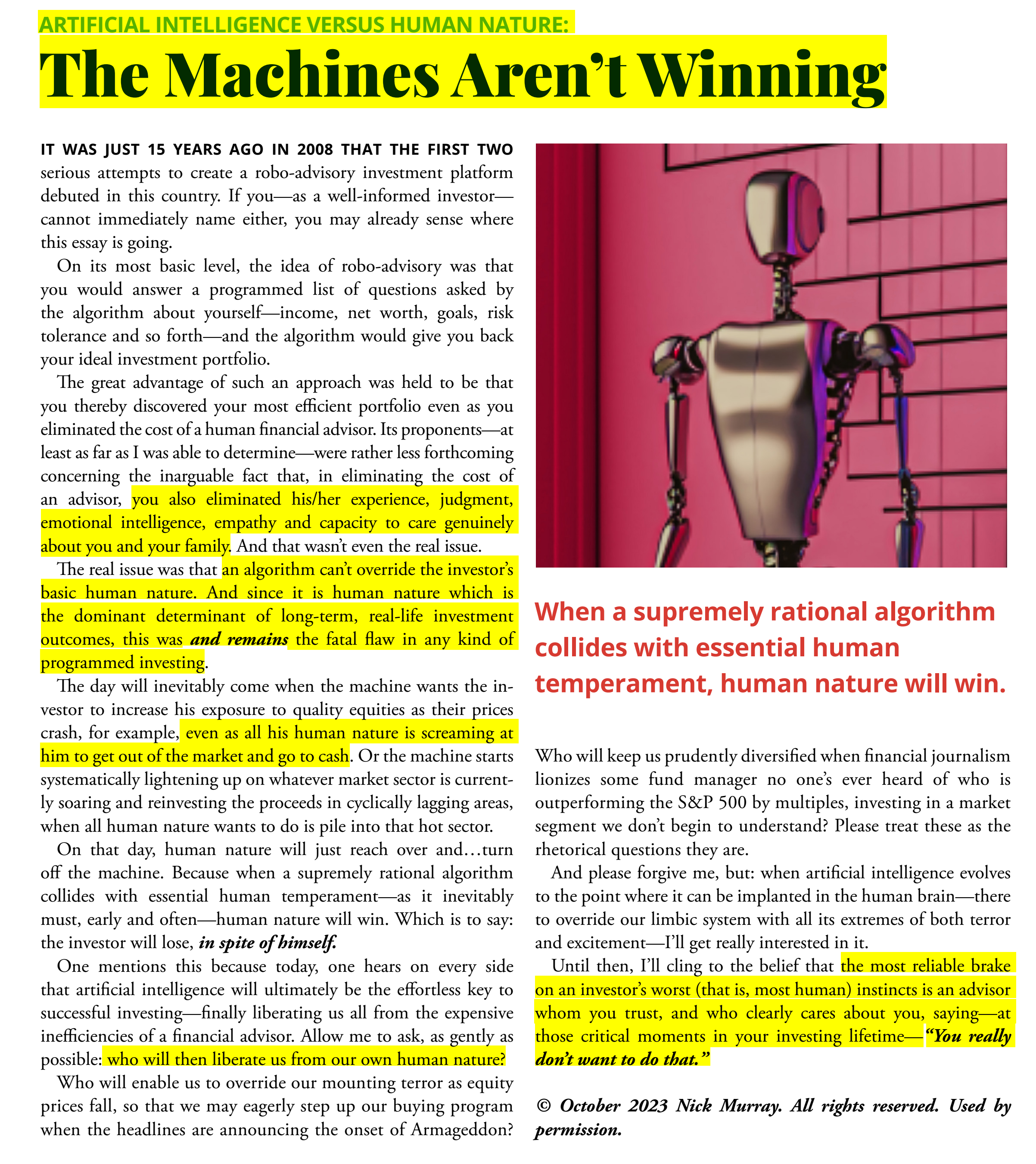
Ever since AI started becoming popular, I’ve gotten questions from advisors about if I believe it will take their clients. My answer has been “no”.
However, the belief that artificial intelligence is a valid substitute for a good financial advisor will take clients from you. That means you need to worry more about people’s beliefs than the tools they use. Because if they believe anything can get them the same (or better) results than you provide, then you’re at risk of becoming obsolete.
Fortunately, good marketers have always known this. We’ve known how important it is to explain our value in a way that resonates with the people we serve.
It’s not enough to say, “I do financial planning,” any more than it’s enough for a chef to say, “I cook food.” People need to feel the difference between a pre-packaged frozen dinner and a hand-crafted, perfectly seasoned meal just for them.
If you fail to communicate that difference, then you leave room for them to believe a substitute (it could be any substitute, not just artificial intelligence) can do the job. And that’s when the drift begins.
Which means it’s becoming more important than ever before to properly articulate your value to prospective clients. If you cannot do that, then you’re gambling with your future.
In the coming years, the ability to justify your value will be the competitive advantage in the financial advice industry. Not “a” competitive advantage. Not “one of many.” THE competitive advantage.
Why? Because as the noise gets louder and the options multiply, the default belief for prospects will shift from “I need a financial advisor” to “I can get this somewhere else faster and cheaper.”
When that happens, the advisors who cannot confidently, persuasively, and repeatedly prove their worth will vanish.