AFW 1.3 — Securities Compliance
3. Compliance
Compliance is operating within the guidelines of the licenses you hold. We're building something great - not something that's going to last just a few years and fade away. This is something that will be around long after we're gone - a business that will be there for our children, and our children's children.
If you're serious about building your future, you have to expand your vision beyond the "here and now." You have to look years down the road and make decisions today that will assure the survival of your business long-term. With ownership you're more than building a business, you're building a legacy that may last for generations to come. That's why compliance matters.
Compliance = business protection. That means keeping watch over your business to make sure nothing happens that could jeopardize your future. Our opportunity is too great to allow any individual or group to damage our credibility, our reputation or our integrity.
Social Media & Websites
For more information about getting your own client website and custom email visit AFW 4.14
As the regulatory oversight of social media and other communication with the public comes under heightened scrutiny, it is imperative that all representatives are vigilant about how they communicate through social media and other mediums. Adhering to the firms policies and procedures minimizes the risk to yourself, the firm and your clients.
It has been noted that a number of representatives have been using social media sites to post profiles, that include the fact that they are registered representatives or investment advisor representatives with IPLLC. Per FINRA, social media sites are deemed to be advertisements and therefore special monitoring, archiving and approval of the sites is required.
Below is IPLLC’s requirement to maintain the social media sites:
-
If you have a website or are listed on a social media site such as LinkedIn.com, Facebook.com, X.com or other social media platforms, you must submit your social profiles and/or website(s) to IPLLC compliance at compliance@innovationpartnersllc.com for review and approval.
-
Advertising Rules apply to all websites. All websites must be sent to FINRA for approval. All fees must be paid before websites will be submitted to FINRA.
-
Sign up with Global Relay for the monitoring of your social media website. You will receive a separate email from GLOBAL RELAY with instructions regarding the submission of your website and social media information.
Our position on no-sales-charge (NAV) mutual fund trades
Your 'discount' is your commission!
With some fund companies a Registered Rep could write his own sale, or those of a family member, and avoid the A-share sales charge. If you were to bypass the sales charge, no one gets paid. Not you. Not your manager. Not even IP. It is contrary to the our business philosophy, and it's bad for your business.
We don't charge our clients more than we charge ourselves. I believe there should be no "wholesale" / "retail" pricing distinction in our business. We are all clients and should pay the same as non-Rep clients do. It is very powerful to be able to make this statement to your clients (and downlines!).
If price is the issue, then price isn't the issue. Why do you feel the need to give a discount to the client? Is the client asking for it, or are you leading with the discount?
Most importantly, by giving a discount to yourself and family you are not living the philosophy of "do unto others as thyself". There is tremendous leverage when you can tell a client that you pay the same costs as they do.
Script
"Mr. Client, I realize that this upfront expense seems like a lot, however this is what it takes to get the finest investment company to manage your money for you. Every client pays it, even I and my family paid. Just because I represent them, doesn't mean I get a discount, but I so believe in their ability that I gladly paid it."
Use of the term 'Financial Advisor'
When you hold a Series 65/66 license then you can call yourself a Financial Advisor. With merely a Series 6/7 you are a Registered Rep.
Fund Suitability & Risk Questionnaire
Non-Licensed Assistant
-
It is possible to register a non-licensed person with FINRA who can help with client service. There is $25 monthly fee and includes a company email address.
-
You can have an assistant, spouse, partner, adult child, etc registered with FINRA as a non-licensed Assistant.
-
This will allow him or her to talk to clients to help with paperwork or answer non-product questions.
-
He/she has to do is get fingerprinted:
-
Go to www.brokerFP.com to find a location and schedule an appointment.
-
Fingerprints will cost the applicant $17.50 paid directly to the fingerprinting service.
-
IP's fieldprint code: ???.
-
For "employer" write: ???
-
-
After getting fingerprinted, send an email to IP informing them about that the fingerprinting was completed and to which Advisor the Assistant is "attached".
-
The Advisor will be billed $25 per month (not the Assistant).
-
The duties of an assistant can be varied, mostly depending upon what the Advisor needs him/her help with. But some of the more common ones include:
-
Paperwork.
-
Following up with prospects, clients and downline Advisors. You can give American Funds permission to ask questions about clients accounts, on your behalf.
-
Staying abreast of what's happening in IP / AdvisorFirst Group and helping the Advisor digest it.
-
Learning new procedures and helping the Advisor learn them.
-
Writing life insurance and living trust business.
-
Accepting Cash
You are PROHIBITED from accepting the following from your clients:
- CASH
- MONEY ORDERS, in some cases a client can add money to an existing account via a money order.
- CASHIERS CHECKS, in some cases a client can add money to an existing account via a cashier check.
- TRAVELERS CHECKS
Customers must have a U.S. checking account for writing checks or a savings account for automatic drafts in order to make securities purchases.
Any attempt to pay for a securities transaction with cash or non-traceable cash equivalents must be reported to the Compliance Department immediately.
Paying Clients for Referrals
You can pay clients for referrals just as if you were to buy leads through an lead generating service. But, you must buy every single lead. The payment for the lead must be fixed and can not be contingent on a sale or in any way price determined by a sale.
For example, you could pay $50 for every lead referred. You can not pay the referring person if a client calls and opens an account but then not pay when the client doesn't open an account; that would be paying a referral fee contingent on a sale which is prohibited. Obviously the risk is that the leads are bad and you don't bring on any new clients from it, but that is the risk with buying any type of lead.
Giving and Receiving Gifts
The prohibitions in Rule 3060 generally do not apply to personal gifts such as a wedding gift or a congratulatory gift for the birth of a child, provided that these gifts are not “in relation to the business of the employer of the recipient.” In determining whether a gift is “in relation to the business of the employer of the recipient,” members should consider a number of factors, including the nature of any pre-existing personal or family relationship between the person giving the gift and the recipient, and whether the registered representative paid for the gift.
When a firm bears the cost of a gift, either directly or by reimbursing an employee, FINRA presumes that such gift is in relation to the business of the employer of the recipient. The analysis of whether a gift is “in relation to the business of the employer” is required in connection with all gifts; firms should not treat gifts given during the holiday season or for other life events as personal in nature.
-
You can give and receive gifts of any value from someone who is not a client.
-
You can give and receive gifts of any value from a client so long as they do not have a relationship with you as an RR through their employer (such as a wholesaler).
-
You cannot give nor receive gifts in excess of $300 in value in a year from anyone who has a relationship with you as an RR through their employer.
Providing the Prospectus
Every time you do business with a client you must present them with a summarty prospectus. You can email the PDF to them, share the link with them or include it in the Docusign agreement (that's what I do). For American Funds you can find them under the "Resources" section of each fund.
Share Classes Suitability & Breakpoints
A-Shares vs C-Share Suitability
Recently, the SEC and FINRA have tackled the topic of share class suitability. The two regulatory bodies have shown concern that investors are being overcharged by brokers who have directed clients to C share classes rather than realizing breakpoint discounts with A shares. FINRA has conducted numerous “sweeps” of brokerage firms looking for these sales abuses, and has issued more than $50 million in fines and investor restitution.
-
A-shares have up-front sales charge (UFSC) but the lowest annual expense. The up-front sales charge is reduced by investing larger amounts within a 13-month period (called "breakpoints"). It's a one-time fee, then a very low-cost forever. The UFSC pays for two things: high quality active management and a professional coach (you).
-
C-shares and F-shares have no up-front sales charge but a higher annual expense, which stays constant throughout the lifetime of the account (exception: American Funds reduces the annual expense of C-shares (not F-shares) after 8 years to that of an A-share). C-shares also have a 1% contingent deferred sales charge (CDSC) for one year.
-
For investors who are extremely confident that their time horizon will be less than five years and the investment amount is less than $500,000, then C shares aare the better option ("5 and 5").
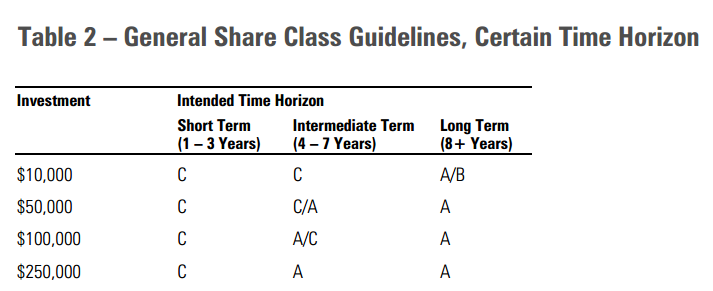
Two factors must be considered when evaluating the appropriate share class for an investor
-
The investor’s investment amount.
-
Time horizon.
As stated above, C-shares tend to cost more for a client than A-shares, thus the use of C-shares needs to be properly defended. Here are some tips:
-
"I can provide better long-term service with C-shares because my compensation is spread over a longer time frame, than with an A-share in which the compensation is mostly upfront" is not a valid argument with FINRA. They expect Registered Reps to provide the same level of services regardless of the compensation method.
-
Valid: the client may want to withdraw or move the money to another account within 1 - 5 years. Such as a variable annuity or fee-based account.
-
Valid: the client insists that they are adverse to the upfront sales charge of A-shares. They want all their funds invested in the market immediately.
-
Note: if you are investing in American Funds C-shares make sure to mention that after 8 years the annual expense reduces.
Understanding A-Share Breakpoints
Vist the AF Master Spreadsheet: Commission Calculator to see the individual breakpoint schedule for American Funds.
-
All immediate family members' accounts count in aggregate to reach the breakpoints.
-
Children under age of 21 count towards the family breakpoint - and their account benefits from the higher breakpoint as well. Once they turn 21 they no longer count towards the aggregate. Note: AMF does not do an automatics sweep of all accounts, so your clients may benefit from the reduced up-front sales charge for a longer time. Make sure to inform your client that that is not guaranateed.
-
When adding new money to an existing account, it is the combined value of all accounts or their total depostis (minus withdrawals), whichever is greater, that counts toward reaching a breakpoint.
-
At $1M there is no upfront sales charge, but there is a 1% CDSC for 18 months.
Quote
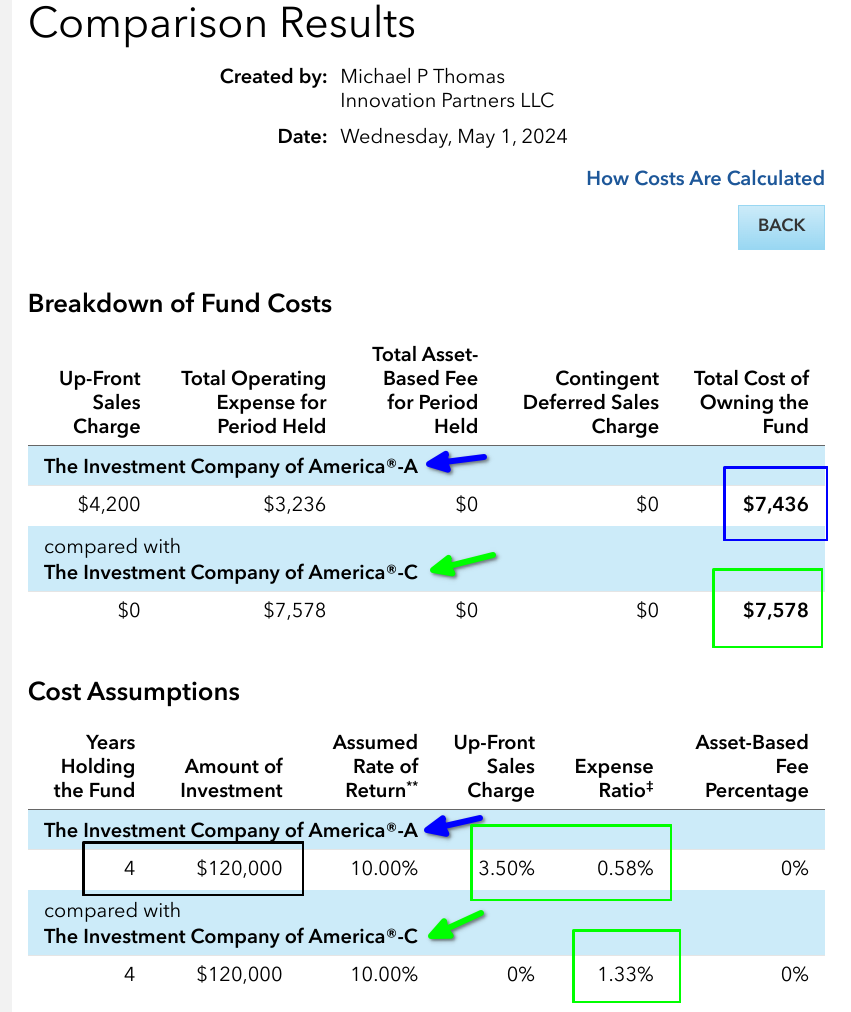
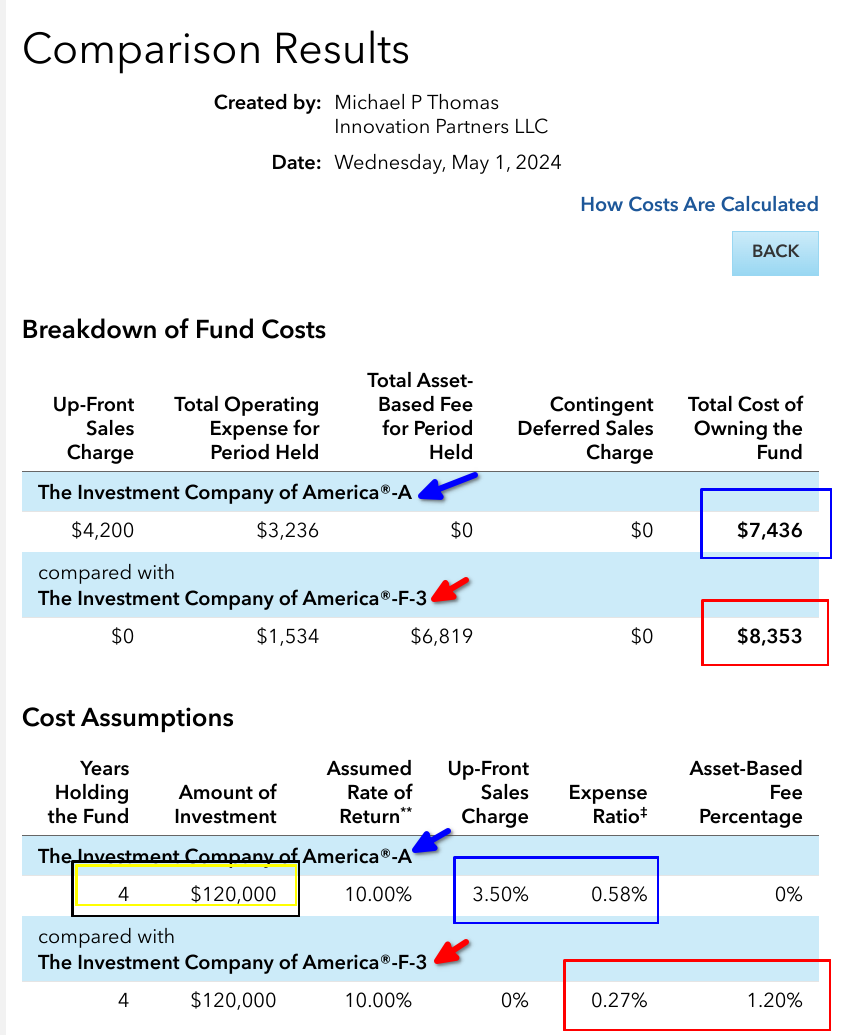
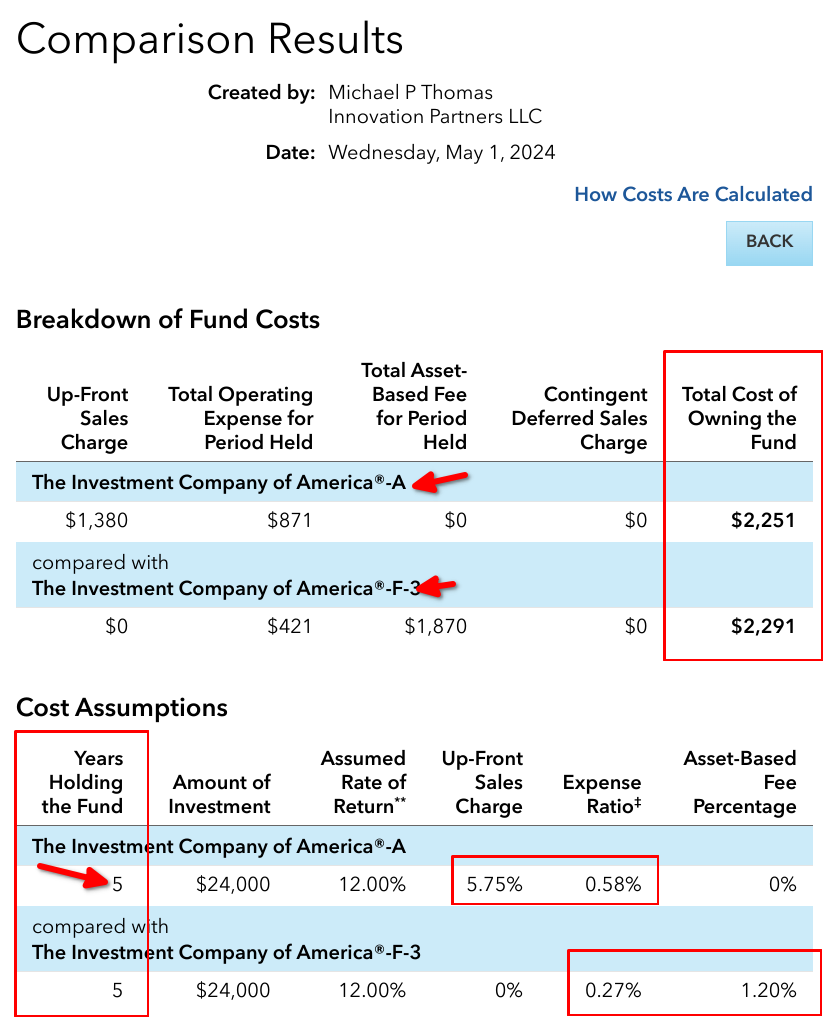
"My underlying philosophy on share classes (and B/D vs Advisory) is: if the investment is the same, and the Advisor is the same, then fees are important, and thus the Advisor should select the class that is the most inexpensive for the client. Remember, the cost is never just the raw cost itself - it's what the additional cost would have grown into had it stayed in the investment." -Michael
For more insight on Advisory/Fee-Based business visit AFW 1.1.28.
Pro-Tip
The most accurate tool for determining the best share class for you client is to run a hypotherical illustration of actual mutual funds with all the share classes. Whichever results with the most money for the client is the best. If you're ever in doubt - run a hypo!
A client has an existing American Funds account of $50k in C-shares. You open another account for the same client for $60k A-shares. Which breakpoint does the new $60k qualify for?
- $100k. C and A-share count together.
- $50k. C and A-share don't count together.
Answer
- $100k. C and A-share count together.
Further Research on Share Classes
-
Please read Nick Murray's article "Explaining Fees" on page 83 of the Nick Murray Reader
-
Read AFW 4.9: Compensation.
Client Requests Account Liquidation
Customer account liquidation requests must be handled with the utmost care.
-
Ensure that you receive the request in writing (either by mail or email).
-
Ensure that you provide the client with information of how the liquidation will affect the account.
-
Provide information regarding fees, and surrender charges, administrative fees and any other fee associated with the liquidation to the client.
-
Keep written notes/records of all phone conversations with the client (date and time of call, comments and transcript of discussion, recommendations, documents discussed, title and document number of educational materials and company name).
-
Inquire about any issues that the client may be having financially, or if there were any changes to economic status, family etc. that would have caused the full or partial liquidation of an account
-
Our account administration and compliance department may request information regarding the liquidation and as such all representatives must provide documents upon request.