AFW 1.2 — Investment Principles — #2: Four Core Principles to Long-Term Investment Success
2. Four Core Principles
Info
These investment principles are based upon the article "Stop Managing Money" (pages 101 - 104) from the book The Nick Murray Reader ebook. Principles #1 and #4 are the two primary lessons from Nick's book Simple Wealth, Inevitable Wealth.
Resources
-
Watch AF MKOM 1646 - My 2nd Favorite Client Piece of All-time
-
Watch the 1st video summary Investment Principles - 7 Core Investment Principles (version 1)
-
Watch the 2nd video summary Investment Principles - 7 Core Investment Principles (version 2)
I've used these four principles, variations of them, over the years as a reference for my clients and as a way to keep the most important concepts of investing front-and-center in my mind.
Remember, credibility is the one ability you can't give yourself, so instead of presenting yourself the "authority" reference one of the principles as a source of credibility. For example, a client may state that he wants to invest in individual stocks and your responses could be, "Well, there are four universally accepted investment principles that any professional advisor worth his salt adheres to, and part of #1 is to be well diversified in the world's great companies."
Pro-Tip
- Refer to Warren Buffet and Nick Murray as credibility sources, as well. Such as quotes and principles.
1. Invest in the World's Great Companies via Mutual Funds
Quotes
-
“I'm 100% in equities. You're never going to make enough money if you have 40% of your money in bonds.” -Andy Sieg
-
"Be an Owner, Not a Loaner. Invest in equities. Own a piece of the world's great companies." -Michael Thomas
-
"Equities are the only asset class that fully captures human ingenuity, which is the most valuable asset on earth." -from Nick's ATY Sep 30
-
"The prime mover of progress is human ingenuity. And the most complete manifestation of that are the world's best publicly-traded equities." -from Nick's ATY Sep 30
Resources
-
Read Nick's ATY 273 September 30 - The Genius of Equities
-
Read Nick's NMS 05 - Equities - a personal statement
-
Read Nick's ATY 037 February 06 - Truth and Stress
-
Read Nick's ATY 094 April 04 - Casino Chips vs Shares of Companies
-
Learn more about mutual funds here.
Script
"I invest in a broadly-diversified, professionally-managed collection of the world's great publicly-traded, mainstream, profit-seeking companies. Specifically, a portfolio of 100% equity mutual funds with good long-term historically defensible returns."
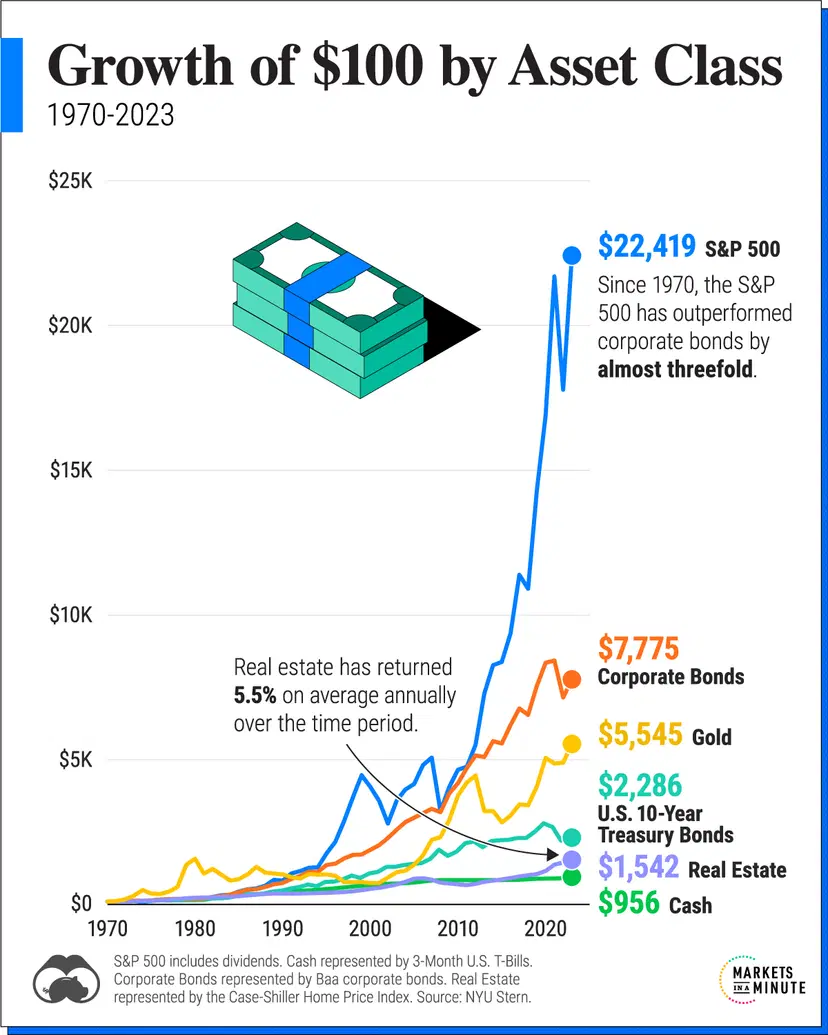
9 Facts of the U.S. Equity Market Since 1926
Resources
-
Watch AF MKOM 1693: Equity vs Income Portfolio For Income? + Nick’s February Advisor Newsletter
-
This section is the Lifeboat Drill and The Package.
-
Read Nick's This Time Isn’t Different #5 - Part 1.4 - The Package
-
Read Nick's This Time Isn’t Different #6 - Part 1.5 - The Package Eliminates Surprises
-
Read Nick's This Time Isn’t Different #7 - Part 1.6 - The Package in More Recent Times (2000 - 2024)
-
Read Nick's This Time Isn’t Different #8 - Part 1.7 - We Planned for This)
-
This section is taken from the article "The Capital Markets, Standing On One Leg" in Nick Murray's newsletter 2014 November
Stats Since 1926...
-Sources1
-
Performance stats:
- Inflation: 3.1%
- Bonds: 6%
- Large U.S companies: 10%
- Small U.S companies: 12%
-
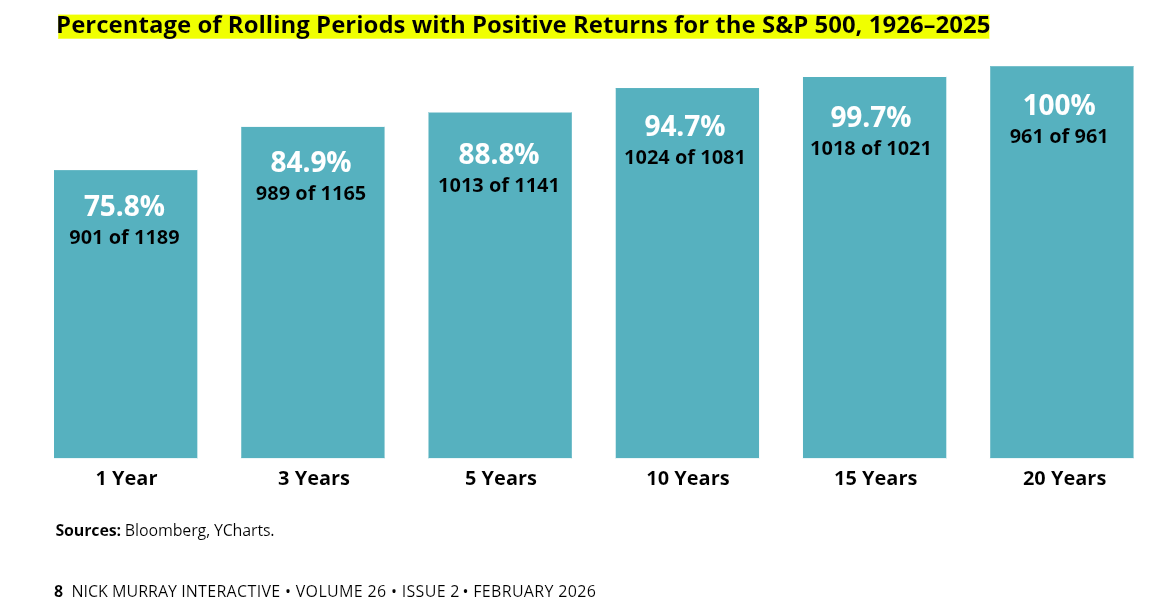
Out of the one hundred year (1,189 months), 12-month rolling-periods the market's return has been positive 75% of the time.
-
However, the market very rarely returns anything close to 10% in any given year. In the 100 years 1926 through 2025, the market has come within two percentage points of 10% (8% - 12%) only seven times. The best year returned 54%, and the worst year was down 43%.
-
Declines of -5% occur about twice a year.
-
Declines of -10% occur about once every 18 months.
-
Declines of -15% occur about once every three years.
-
Declines of -30% occur about once every six years ("Bear Market")2
“Our plan continues to anticipate that at least 20% of our invested capital will appear to disappear temporarily about every five years or so.” ―Nick Murray
-
40 months (~1,200 days) is the average length of time it has taken for a Bear Market to breakeven.
“Since the end of World War II the longest it has ever taken an investor to recover an original investment in the stock market was the five-year, eight-month period from August 2000 through April 2006 (68 months).” —Jeremy Siegel, [Stocks for the Long Run, sixth edition (2022)]https://www.amazon.com/Stocks-Long-Run-Definitive-Investment/dp/1264269803/ref=tmm_hrd_swatch_0){:target="_blank"}
-
Returns in the first year after the five biggest market declines ranged from 36% to 137%, and averaged 70%.
Insights
- Insight 1: Volatility is not risk.
- Insight 2: You can't outsmart or trick the market.
- Insight 3: The Market Does What it Does. If you know what's going to happen, it's not risky.
- Insight 4: They need us... (see Principle #4)
Filter via Historically Defensible Returns
“Always make investment policy decisions based upon history rather than on headlines.” ―Nick Murray
We've been taught that "past performance is not a guarantee of future returns." This is true. But past performance can be an indication of future potential.
Often, it is those who are marketing funds with poor historical returns who promote the idea that past performance is irrelevant. One should strongly consider investments that have historically defensible returns with at least a 10+ year track record, preferably 30+ years. You must, of course, take into account the tenure of the current fund manager when looking at past performance (see the American Funds' Capital Group System).
Rolling Periods
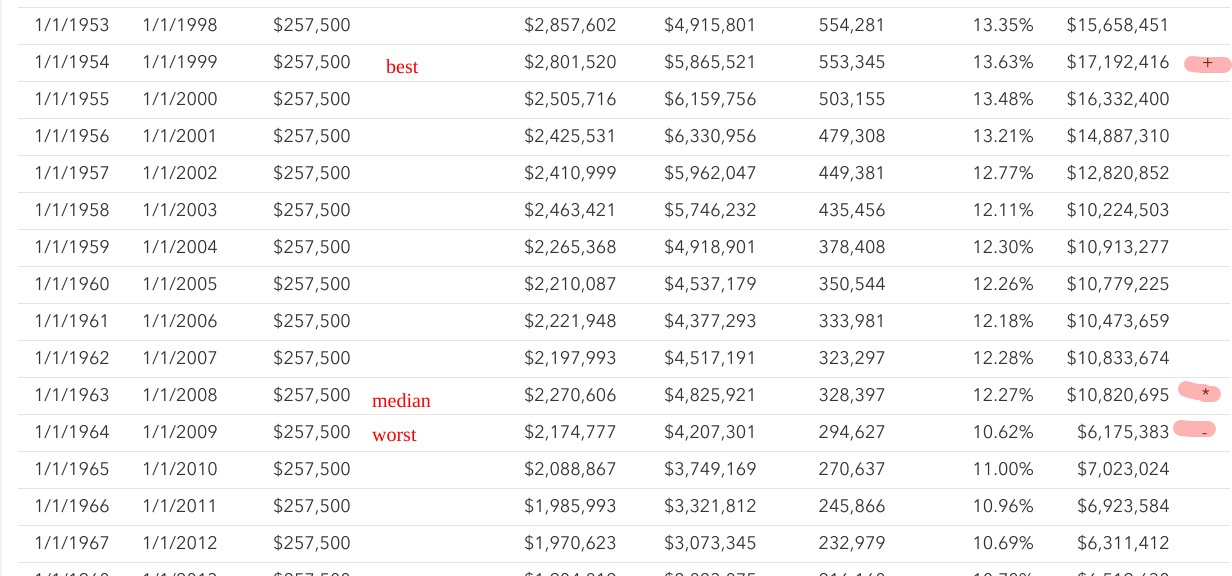
The best indicator of historically defensible returns is to use rolling-periods of at least 10 years. The older the fund is the more "legitimate" the illustration is. Promote the median and worst rolling-period. The example below below is of the American Funds Washington Mutual fund illustrating 45-year rolling periods.
Resources
- Read Nick's ATY 071 March 12 - Perspective is the Bridge
2. Maximize Tax Shelters
- Always use tax shelters when possible (and fully-fund them), such as: IRAs, 401ks, Variable Annuities, 529-plans etc.
3. Have an Intelligent Withdrawal Strategy
-
Equity mutual funds + a side-fund.
- Variable annuity with a guaranteed income rider.
4. Investor Temperaments
Info
This section is based upon Nick Murray's "Two Keys to Investment Succss: 1) Invest in something with historically defensible returns; and 2) Have faith in the future.
Quotes
-
“Without an adequately compensated advisor to help with selection and discipline, the individual investor will simply make all the classic and horrendous mistakes.” ―Nick Murray
-
"People make better decisions with financial advisors." ―Robert Shiller, Nobel Prize-winning economist
Temperament 1: Faith in the Future
Quotes
-
“For 200 years, pessimists have had all the headlines, even though optimists have far more often been right.” ―Matt Ridley
-
“Despite what we hear on the news and from many authorities, the great story of our era is that we are witnessing the greatest improvement in global living standards ever to take place.” ―Johan Nordberg
-
Unless you are a short seller, it never pays to be pessimistic. ―Peter Lynch
Resources
-
Read Nick's This Time Isn’t Different - #34 - Part 2.16 - Optimism Is the Only Realism
-
Read Nick's ATY 045 February 14 - Leader vs Manager
-
Read Nick's ATY 114 April 24 - Past Predicts
-
Read Nick's ATY 115 April 25 - Optimism: Still the Only Realism
-
Read Nick's ATY 116 April 26 - All Technology is Information Technology
-
Read Nick's ATY 121 May 01 - The Engines of Our Optimism
-
Read Nick's ATY 122 May 02 - Engines 2 & 3 and a Question
-
Read Nick's ATY 173 June 22 - Faith
Faith is the first characteristic of all successful long-term investors. It is impossible to invest successfully in a future of which one is fundamentally afraid. Thus, the great enemy of investment success isn’t ignorance, but fear. All human experience goes to teach us to have faith in the future, and especially faith in the world's economy.
I cannot be frightened out of my long-term portfolio because I believe in human ingenuity, and therefore I cannot fail to achieve superior real-life returns.
What is the alternative? Armageddon? Apocalypse? If that really happens, then nothing matters anyway. The only rational mindset is faith in human progress. Stop trying to prove anything. You can't prove the sun's coming up tomorrow, nor that you or your client will be here to see it even if it does. A great advisor never accepts the burden of proof. Never pretend to know the future, except that you have faith in it. You cannot guarantee the future, you can only plan for it.
Temperament 2: Patience & Discipline
Quotes
-
"If you can't ride out about a fifteen percent decline virtually every year, and an average of twice that perhaps one year in five, you simply can't be an equity investor. And we have agreed that without the historical return of equities, we know of no other way for you to achieve your financial goals. My greatest value to you will be coaching you through these episodes, but we must be fully aware that they're randomly coming, like summer thunderstorms, to be followed by bright new days." -from Nick's ATY October 03
-
“If you're going to be in this game for the long pull, which is the way to do it, you better be able to handle a 50% decline without fussin' too much about it.” -Charlie Munger
-
“Unless you can watch your stock holding decline by 50% without becoming panic-stricken, you should not invest in the stock market.” ―Warren Buffett
Resources
- Read Nick's ATY 174 June 23 - Patience & Discipline
-
- Capital Group's article (February 13, 2025), Should investors be nervous about the stock market?.
- Nick Murray Interactive 2024-11.
- Nick Murray Interactive 2024-12, 1st article.
- Nick Murray Interactive 2025-2, "99 Years of “Volatility”" article.